
Security Brief | 2026-07-09 | 13 min read
Security Brief: Wildfire Readiness for Hope & Chilliwack Businesses
A practical wildfire-readiness guide for Hope, Fraser Canyon, and Chilliwack businesses covering evacuation stages, road disruption, smoke, temporary closures, site-security decisions, reporting, and re-entry planning.
Wildfire Readiness for Hope & Chilliwack Businesses
Wildfire-related disruption can affect a business even when the property is not beside an active fire.
For businesses in Hope, the Fraser Canyon, Chilliwack, and the eastern Fraser Valley, road changes, smoke, reduced staffing, delayed deliveries, temporary closures, unavailable keyholders, and disrupted alarm attendance can all change site operations.
Official guidance comes first. Use EmergencyInfoBC and the responsible local or First Nation authority for evacuation information, BC Wildfire Service for wildfire status, DriveBC for highways, and BC Air Quality for air quality.
Security coverage can operate only where access is permitted, the assignment is safe, and official restrictions allow the work. Zentra Protection does not bypass evacuation orders, area restrictions, or roadblocks.
This guide covers access control, closure planning, permitted checks, reporting, service decisions, and re-entry.
Download the Hope & Fraser Valley Wildfire Business Site Readiness Checklist
Quick Answer
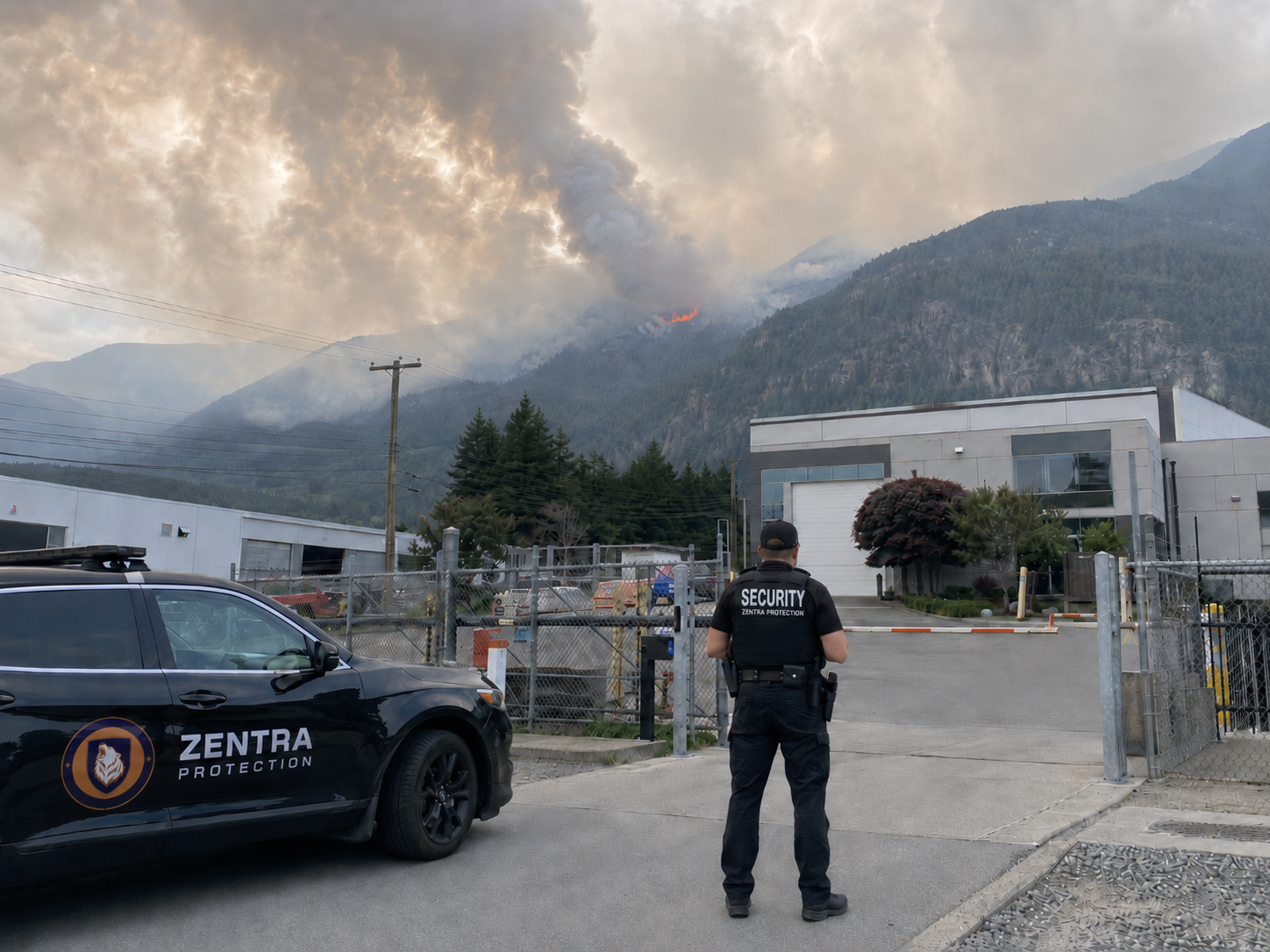
First confirm the official evacuation, wildfire, road, and air-quality situation. Then identify a site decision-maker and backup keyholder, secure access points, update alarm instructions, photograph the property's baseline condition, and decide whether normal security remains enough.
Some sites may need mobile patrol, alarm response, temporary security guards, or construction security. Zentra's dedicated wildfire security services page explains how guard, patrol and recovery support changes across alerts, closures and permitted re-entry. Other properties may need no added service.
Current Hope & Fraser Canyon Wildfire Situation
Content review completed: August 9, 2026 at 1:15 p.m. PT.
Wildfire, evacuation, road, and air-quality information can change faster than an article can be updated. During July 2026, official notices changed repeatedly across Fraser Canyon communities and routes. Those notices are historical context and must not be treated as today's boundaries or access instructions.
Before travelling or arranging site attendance, confirm:
- Evacuation status: EmergencyInfoBC, the FVRD Emergency Operations Centre, and the issuing authority
- Wildfire status: BC Wildfire Service
- Highways 1, 3, 5, and 7: DriveBC
- Smoke and air quality: BC Air Quality / AQHI
- Local notices: District of Hope and City of Chilliwack emergency preparedness
This page does not freeze live fire sizes, highway closures, evacuation-property counts, or AQHI values into evergreen copy. The official source should own those changing facts.
Alert, Order, Area Restriction, and Re-entry: What Changes for a Business?
| Official stage | What it means operationally | Business-site priority | Security limitation |
|---|---|---|---|
| Evacuation Alert | Prepare to leave on short notice and follow the issuing authority | Update contacts, prepare closure, secure and document the site only while safe | An Alert is not permission to delay preparations or ignore changing conditions |
| Evacuation Order | Leave immediately as directed | People and life safety come first; preserve records remotely | Ordinary private-security work does not override the Order, roadblocks, or access rules |
| BCWS Area Restriction or other access restriction | Entry may be legally restricted to protect the public and responders | Stop non-authorized travel and revise site plans | Cameras, keys, contracts, or client requests do not create access rights |
| Order rescinded or re-entry permitted | Return only under the issuing authority's instructions | Check the exterior first, compare with the baseline, and restart systems carefully | Damaged utilities, alarms, structures, or life-safety systems may require qualified specialists |
PreparedBC advises people to follow all Evacuation Alerts and Orders and rely on the responsible municipality, regional district, band office, First Nation, or local authority for direct community information. Review PreparedBC wildfire guidance before conditions become urgent.
The 30-Minute, Two-Hour, and Final-Departure Readiness Plan
The timing below is a Zentra operational framework, not an official evacuation timetable. If an authority directs people to leave, follow that direction immediately.
In the First 30 Minutes
Focus on responsibility and information:
- confirm the official source and affected area
- name the person making site decisions
- confirm a backup keyholder
- update staff, tenants, contractors, and vendors
- verify alarm-monitoring and after-hours contacts
- identify who will complete the final lock-up
- define the trigger for stopping all site attendance
Within Two Hours, Where Time and Safety Permit
Focus on the property's most important exposures:
- secure exterior doors, gates, containers, trailers, and tool storage
- move portable assets, keys, fobs, documents, and fuel where practical
- confirm cameras, remote access, exterior lighting, and internet connectivity
- update contractor and delivery access lists
- photograph gates, doors, fencing, equipment, vehicles, and pre-existing damage
- decide whether normal security remains sufficient
- provide written instructions for any permitted patrol or guard coverage
Before Final Departure
Complete one accountable handoff:
- record the departure time and responsible person
- confirm locks and access points
- save baseline photographs
- provide the current keyholder and escalation list
- confirm who receives alarm calls and security reports
- tell monitoring, vendors, and contractors that operating hours have changed
- record which people still have keys, codes, or authorized access
- state clearly when attendance must stop because access or conditions have changed
Why Wildfire Disruption Creates Property-Security Gaps
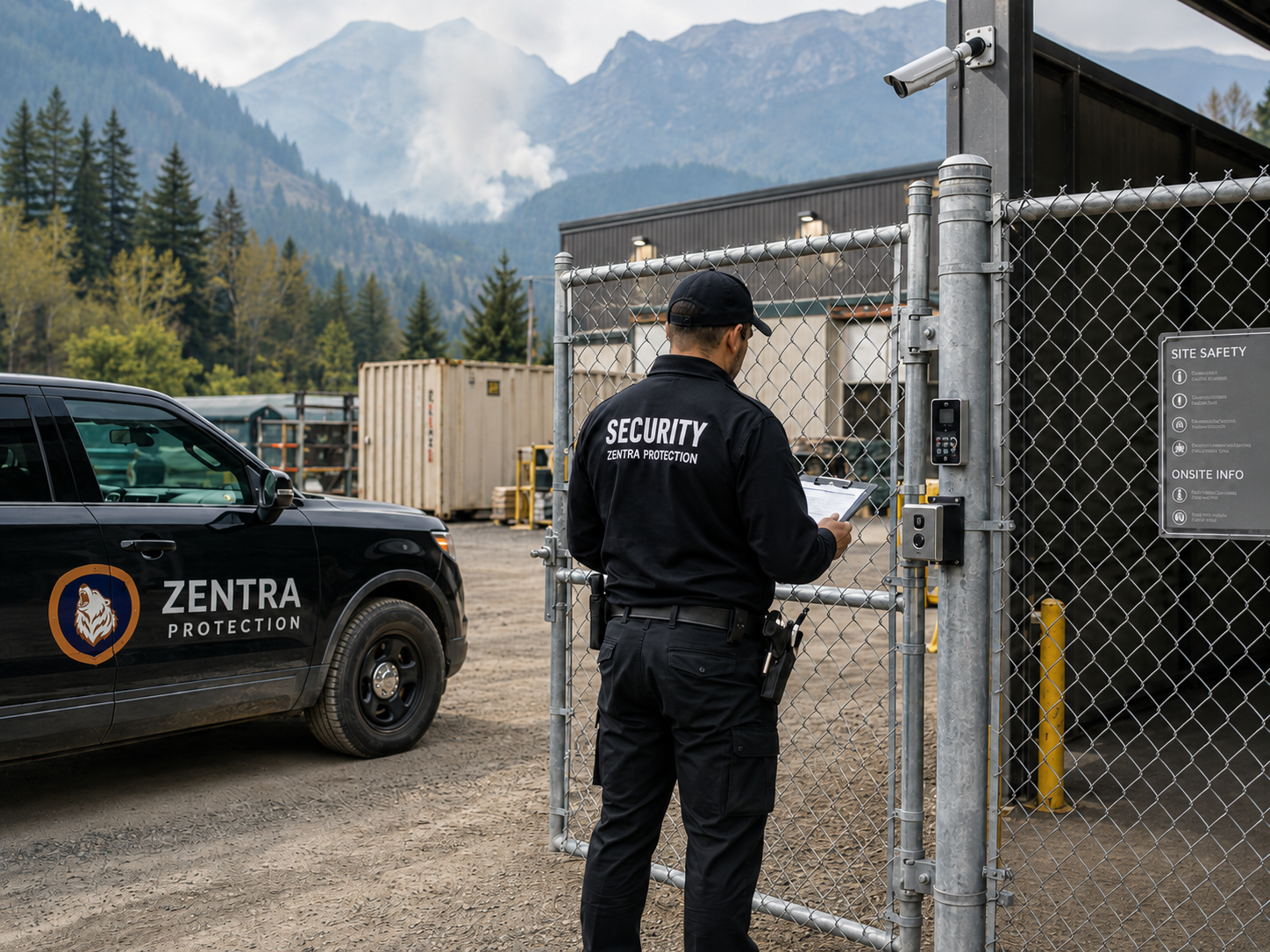
The security issue is usually the operating routine that changes around the property.
A site may close early, a supervisor may be unable to travel, contractors may use different hours, or an alarm company may call a keyholder who cannot attend. Common gaps include:
- no clear final lock-up responsibility
- outdated keyholder or alarm lists
- missed gates, rear doors, containers, or trailers
- tools, fuel, materials, or equipment left visible
- vendors or contractors using old instructions
- loss of power, lighting, internet, or camera access
- no baseline record or stop-attendance rule
A practical plan replaces the normal routine before it disappears.
Hope and Fraser Canyon Road Access: What Changes Operationally
Hope connects Highway 1, Highway 3, Highway 5, and Highway 7. Route conditions can therefore affect keyholders, guard relief, alarm attendance, deliveries, contractor access, patrol feasibility, and a worker's ability to leave safely.
A security plan should not promise normal response times when access is uncertain. It should include a backup keyholder, alternate contact method, route check before dispatch, and a clear decision to delay, modify, or suspend attendance when access is not viable.
For semi-rural or remote projects, review Zentra's remote construction site security guide for Hope and the Fraser Canyon.
Wildfire Smoke and Outdoor Security Work
Smoke can affect outdoor patrols, construction sites, yards, loading areas, events, and other assignments where workers spend time outside.
WorkSafeBC reminds employers to treat wildfire smoke and summer weather hazards as workplace risks. Employers should monitor conditions, assess exposure, communicate with workers, and adjust the work when needed. Depending on the assignment, that may mean changing the schedule, reducing unnecessary outdoor time, moving tasks, increasing indoor or vehicle-based work where suitable, or postponing a non-urgent site check.
Read the current WorkSafeBC summer weather and wildfire-smoke guidance.
Zentra does not provide medical advice or replace an employer's occupational-health-and-safety responsibilities. The security plan should record when smoke, visibility, route conditions, or another workplace concern changed the assignment.
Securing a Commercial Property Before Temporary Closure
A temporary closure is an operating-state change, not just an early lock-up.
Confirm:
- exterior doors, gates, roof or utility access, and loading areas
- containers, trailers, tools, fuel, and outdoor inventory
- who still has keys, codes, fobs, or contractor access
- alarm zones and response instructions for the new schedule
- camera recording, remote access, internet, and exterior lighting
- delivery, cleaning, maintenance, and vendor changes
- report recipients and who can authorize changes
For periodic checks rather than continuous presence, mobile patrol may fit. If alarms are the main concern, alarm response may be more direct. Coverage still depends on lawful access, a viable route, and safe conditions.
Construction Sites, Equipment Yards, and Remote Properties
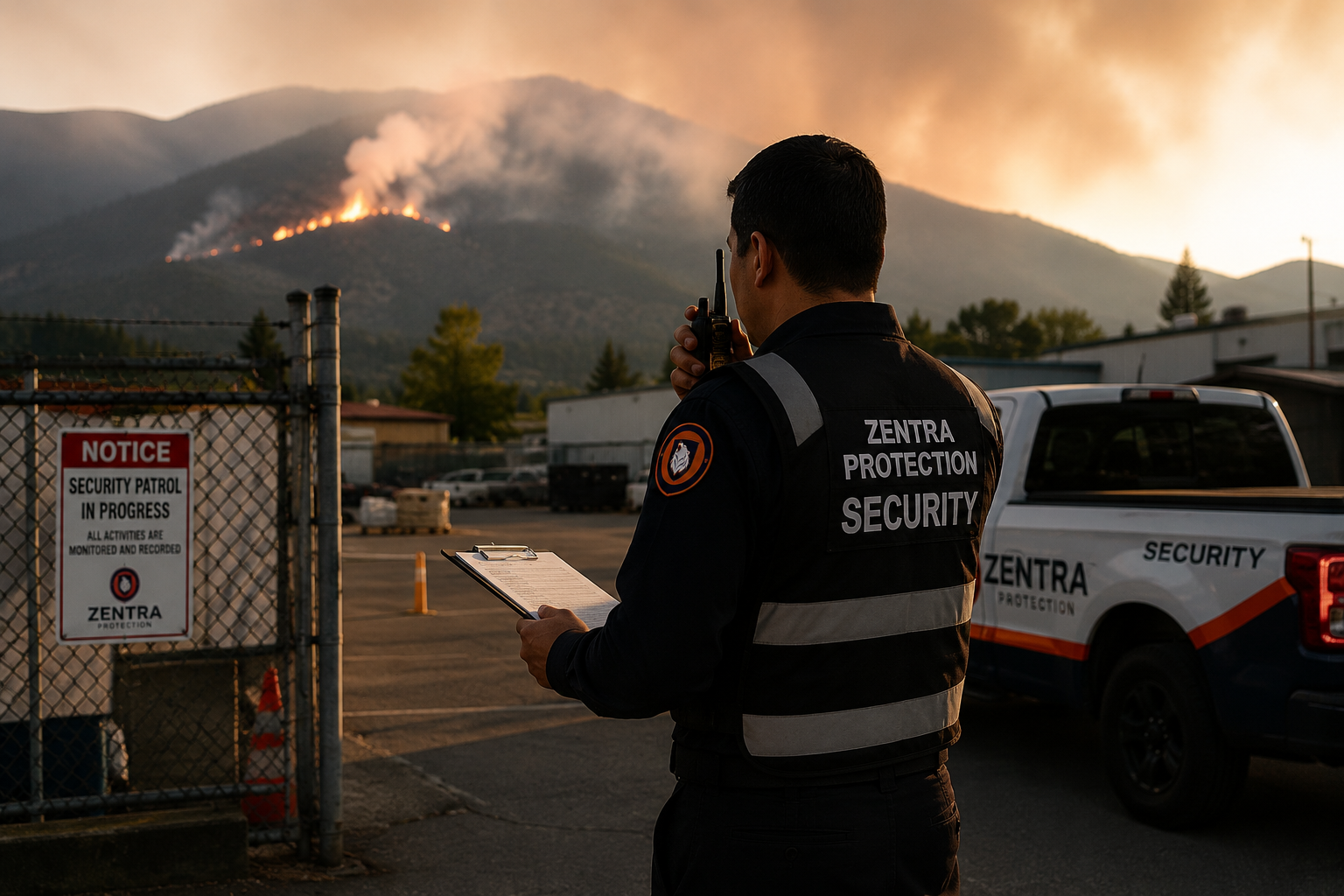
Before a shutdown or reduced-work period, supervisors should review:
- fencing, gates, trailers, tools, fuel, generators, and portable equipment
- material staging and items visible from public access points
- temporary power, lighting, cameras, and internet dependencies
- contractor, delivery, and after-hours access
- communications, check-ins, unsafe areas, reporting, and restart steps
A project may use construction security, patrols, cameras, or a blended plan. Continuous guard coverage is not automatic; the choice depends on access control, asset exposure, site activity, travel, communications, and the need for immediate presence.
Mobile Patrol, On-Site Guard, Alarm Response, or No Added Service?
| Site situation | First decision | Likely response | Important limitation |
|---|---|---|---|
| Business operating normally | Are contacts and normal security still reliable? | Normal security may be enough; no added service may be necessary | Avoid adding coverage without a defined need |
| Alert; business remains open | Can the site close quickly if conditions change? | Update keyholders, access lists, alarms, and patrol instructions | Continue monitoring official information |
| Site preparing to close | What must be secured and documented? | Lock-up verification or scheduled patrol may fit | Only while access remains lawful and safe |
| Temporarily closed property | How often does the site genuinely need checking? | Mobile patrol or property checks | Route and official restrictions apply |
| High-value site with continuing permitted access | Is continuous presence required? | Temporary on-site guard may fit | Worker safety and access must be confirmed |
| Construction shutdown | What assets and access points remain exposed? | Construction security, patrol, or blended coverage | No entry into restricted areas |
| Alarm activates with reduced staffing | Who can authorize and receive a response? | Alarm response and keyholder coordination | Attendance may be delayed or impossible because of roads or Orders |
| Multiple sites affected | Which sites and contacts are highest priority? | Coordinated patrol and escalation plan | Do not promise normal routing or timing |
| Cameras online but no keyholder available | What requires human verification? | Remote monitoring plus permitted checks where appropriate | Cameras do not create access rights |
| Order, Area Restriction, or roadblock prevents access | Can anyone lawfully attend? | No ordinary security deployment into the restricted area | Follow the issuing authority |
| Re-entry officially permitted | Is the exterior safe enough to continue? | Documented condition check and staged security support if needed | Utilities, alarms, or structural concerns may require qualified specialists |
For a broader comparison, read Mobile Patrol vs On-Site Security Guards.
Reporting & Documentation: Baseline -> Permitted Checks -> Re-entry Comparison
Professional security support should leave a usable record, not only a statement that the site was checked.
Stage 1: Pre-Closure Baseline
Record date, time, exterior photographs, gates, doors, fencing, containers, alarms, cameras, lighting, equipment, vehicles, pre-existing damage, authorized access, and report recipients.
Stage 2: Permitted Checks During Closure
Where lawful and safe, record attendance, route limitations, areas actually checked, access-point condition, visible damage, alarm or camera issues, factual observations, photographs, escalation, and the report recipient. State what could not be checked.
Stage 3: Re-entry Comparison
Compare the property with the baseline: new damage or signs of entry, systems and connectivity, equipment and materials, keys and access changes, contractors present, corrective action, notifications, and follow-up.
These records may help owners, managers, supervisors, brokers, or insurers understand the timeline. They do not guarantee insurance coverage or claim acceptance.
For more detail, see what a property security check report should include.
What to Check When Re-entry Is Permitted
Confirm the Order has been rescinded or the issuing authority permits return, check DriveBC, and identify who is authorized to attend.
Start outside. Look for damaged fencing, blocked access, downed services, smoke, water, unusual odours, or other conditions requiring emergency services, a utility, electrician, alarm technician, restoration contractor, or another specialist.
If the exterior can be assessed safely:
1. compare gates, doors, windows, fencing, trailers, and assets with the baseline;
2. photograph new damage or signs of entry without disturbing evidence;
3. check alarms, cameras, internet, lighting, and access control;
4. review keys, fobs, codes, contractors, deliveries, and vendors;
5. restart normal access in stages and document unresolved items.
A separate Response Playbook should own the complete post-evacuation reopening process so this page remains focused on readiness and disruption.
Zentra Field Note: The Weak Point Is Often the Access Routine
During an emergency, the building and fence may not have changed, but the people and routines around them often have.
A regular keyholder may be unavailable. The evening supervisor may leave early. Contractors may use different hours. A delivery may arrive while the site is closed. An alarm contact may no longer be able to reach the property.
A disruption plan should deliberately replace the normal routine with four things:
- one named site decision-maker
- one backup keyholder
- one current access list
- one clear rule for when site attendance stops because official restrictions or conditions have changed
How Zentra Handles Wildfire-Related Site Disruption
Zentra Protection's role is practical site support, not emergency command.
1. Confirm official status. Review the issuing authority, EmergencyInfoBC, BCWS, and relevant road restrictions.
2. Confirm the site's operating state. Open, reduced staffing, preparing to close, fully closed, or re-entering.
3. Identify decision-makers. Primary contact, backup keyholder, and escalation contact.
4. Define accessible areas. Gates, exterior doors, yards, containers, equipment, loading areas, cameras, and lighting - only where access is permitted.
5. Choose the least excessive solution. Normal routine, mobile patrol, alarm response, temporary guard, construction coverage, or no added service.
6. Write site instructions. State what must be checked, photographed, recorded, and escalated.
7. Set access and stop-work rules. Define who can authorize changes and what happens if a route, Order, smoke condition, or site hazard changes.
8. Document each permitted visit or shift. Record time, areas checked, findings, limitations, photographs where appropriate, and notifications.
9. Re-check changing conditions. Roads, official status, workplace conditions, and communications.
10. Suspend or modify coverage when necessary. Zentra does not override an evacuation order, area restriction, roadblock, or unsafe assignment.
Wildfire Readiness Is Not the Same as Fire Watch
Regional wildfire activity does not automatically mean a business needs Fire Watch.
Fire Watch may be required when a fire alarm, sprinkler, suppression system, hot-work process, Authority Having Jurisdiction, insurer, property manager, or site-specific fire-safety condition requires dedicated monitoring.
Wildfire business readiness usually concerns access, temporary closure, property checks, alarms, patrols, reporting, and continuity. Read When Is Fire Watch Required in BC? for the separate life-safety context.
Download the Hope & Fraser Valley Wildfire Business Checklist
The downloadable checklist follows the same practical sequence as this guide:
- before disruption
- during an Evacuation Alert
- during an Evacuation Order or access restriction
- permitted checks during temporary closure
- officially permitted re-entry and restart
Download the Hope & Fraser Valley Wildfire Business Site Readiness Checklist
Official Sources to Monitor
- EmergencyInfoBC - evacuation events and supports
- BC Wildfire Service - wildfire incidents and provincial situation
- FVRD Emergency Operations Centre - Fraser Canyon notices
- DriveBC - highway information
- BC Air Quality / AQHI - air quality
- PreparedBC wildfire guidance - Alerts, Orders, and evacuation guidance
- WorkSafeBC summer-weather guidance - employer planning
- District of Hope, Hope FireSmart, and City of Chilliwack emergency preparedness - local information
About This Guide
This guide was prepared by Zentra Protection for BC business owners, property managers, contractors, and site supervisors.
Zentra provides licensed private-security services. Evacuation, wildfire, road, workplace, and air-quality decisions should be based on official authorities and qualified professionals.
Review security services in Hope, BC or Chilliwack security services. For temporary coverage, contact Zentra Protection with the site, access, hours, responsibilities, and current conditions.
Frequently Asked Questions
Is Hope under an evacuation alert or order right now?
Check the issuing authority, EmergencyInfoBC, FVRD, and District of Hope. This article does not provide a timeless yes-or-no status because boundaries change.
What should a business do during an evacuation alert?
Prepare to leave, update contacts, secure and document the property only while safe, and define what happens if the Alert becomes an Order.
Can a security guard stay behind during an evacuation order?
Not simply because a client requests it. Private-security work does not override an Order, restriction, roadblock, or official direction.
Can mobile patrol check a property during wildfire disruption?
Only when the site is legally accessible, the assignment is safe, and the route is viable. Coverage must change when those conditions change.
What should a business secure first?
Start with contacts, gates and doors, keys and fobs, portable assets, alarms, cameras, and a quick photographic baseline.
What should be photographed before closure?
Photograph gates, doors, fencing, containers, major equipment, trailers, vehicles, exterior condition, and pre-existing damage.
What happens to alarm response when a highway is closed?
Attendance may be delayed, rerouted, or impossible. Use a backup keyholder, realistic escalation, and a rule for when response cannot proceed.
Does wildfire smoke affect outdoor security work?
It can. Employers should monitor conditions, assess exposure, communicate with workers, and adjust or postpone work under their safety plan and WorkSafeBC guidance.
Can cameras replace property patrols?
Cameras support awareness but do not verify a lock, inspect outside their view, manage access, or create permission to enter a restricted area.
What is the difference between wildfire readiness and Fire Watch?
Wildfire readiness concerns disruption, access, closure, patrols, alarms, and reporting. Fire Watch is a separate life-safety measure tied to impaired systems, hot work, or an authority or site requirement.
What should be checked when re-entry is permitted?
Start outside and compare gates, fencing, doors, assets, cameras, lighting, and systems with the baseline. Stop and call the appropriate specialist when hazards are present.
How should a construction site prepare for closure?
Confirm fencing, gates, trailers, tools, fuel, materials, cameras, temporary power, contractor access, communications, reports, and restart steps.
Related Zentra Services